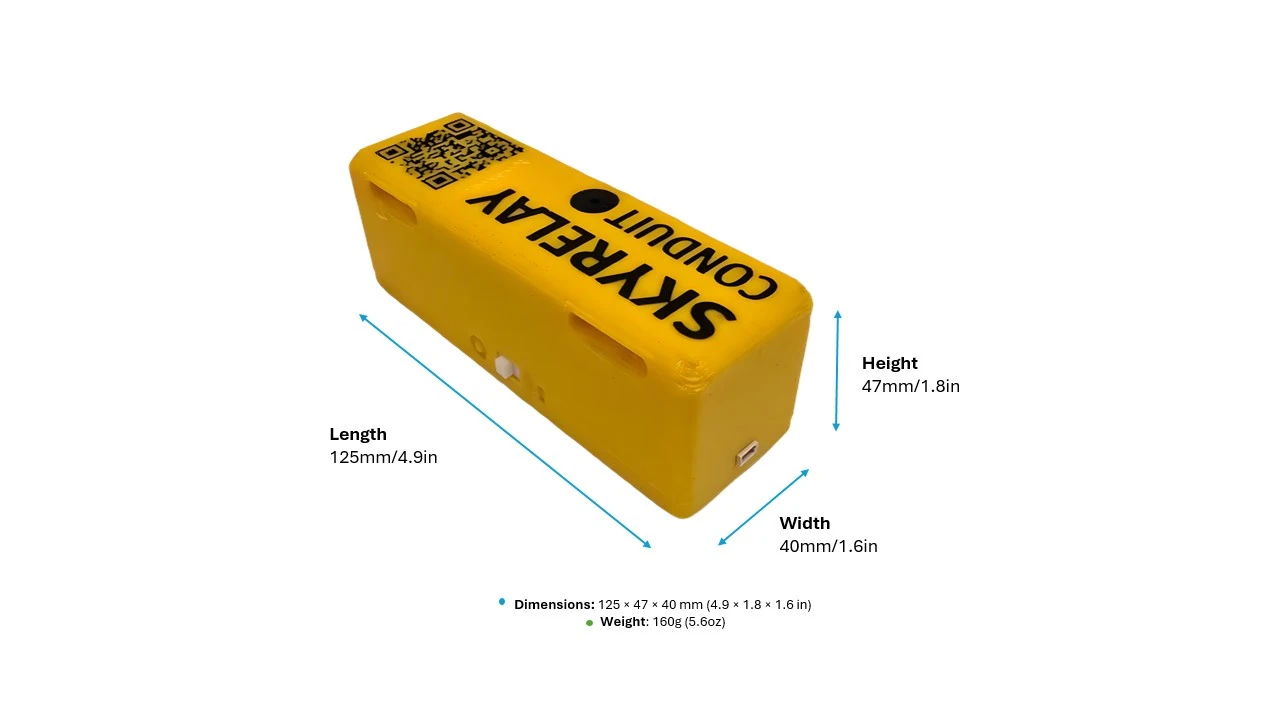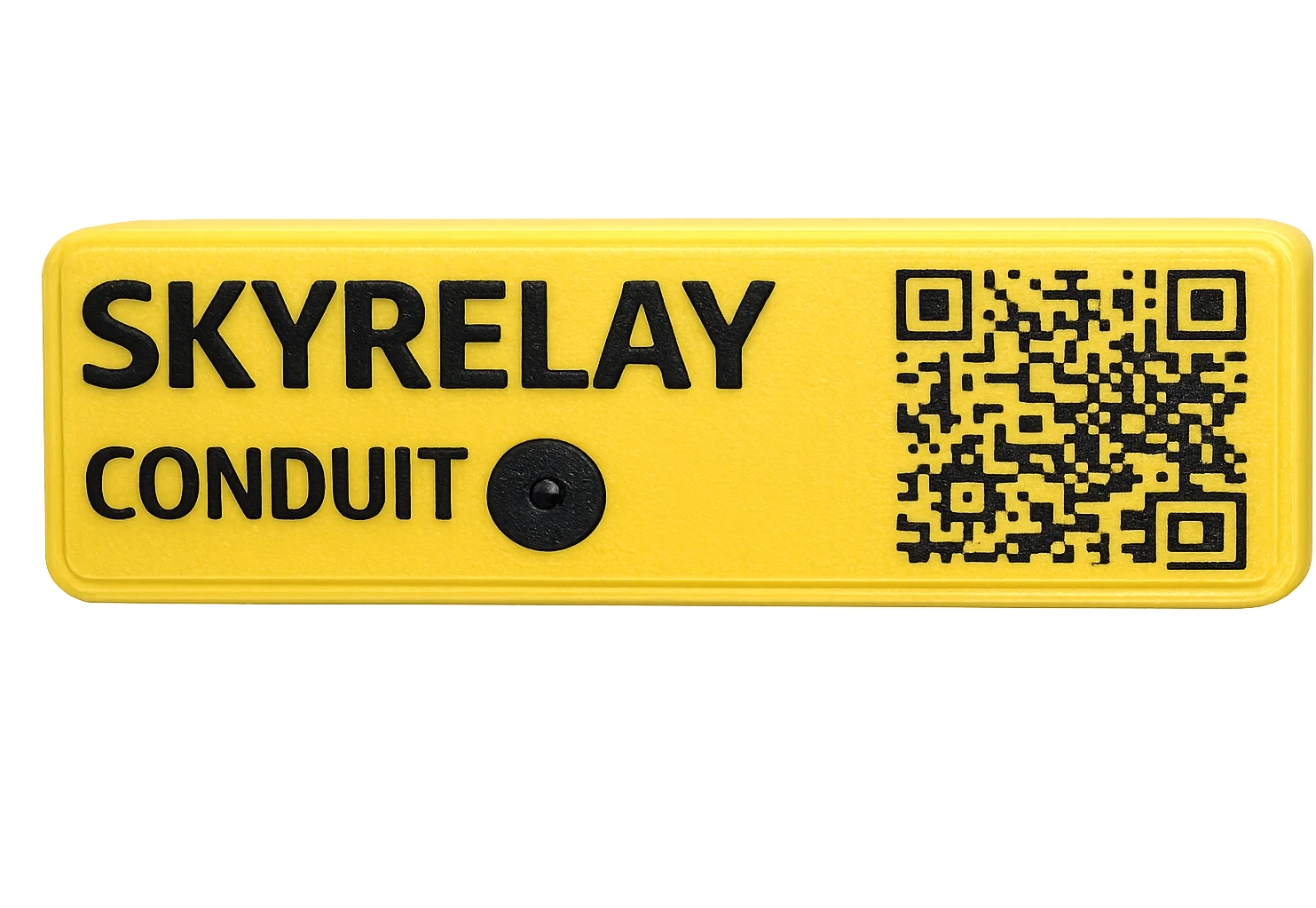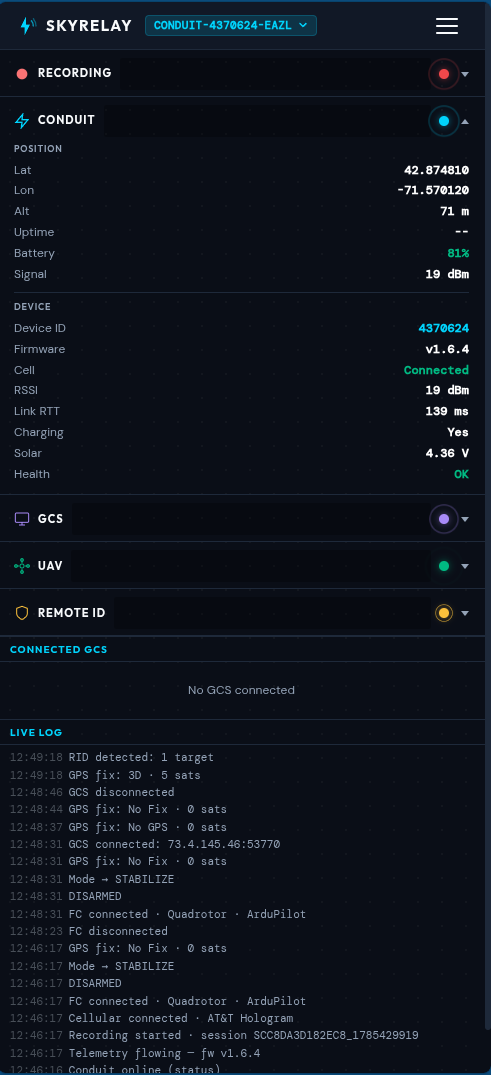
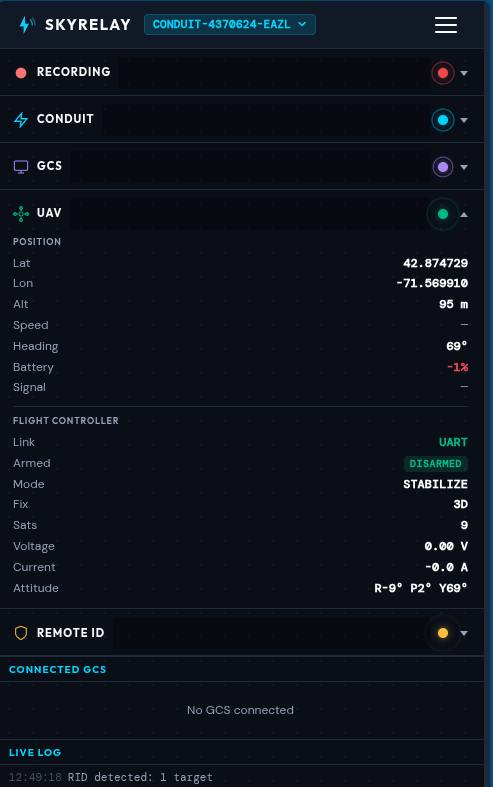

A pre-configured LTE Cat-1 module with integrated GNSS, pre-flashed and SIM-activated before it ships — mount it once and it records, locates, and backstops the link on its own, apart from the manufacturer and apart from the pilot.

Each of these stands on its own. None of them depend on trusting the aircraft's own systems to tell the truth about themselves.
The Conduit doesn't commit to one network. It evaluates signal across AT&T, T-Mobile, Verizon, and 550+ partner networks through Hologram, and moves to the strongest available carrier automatically. A dead zone on one network isn't a dead zone for the aircraft.
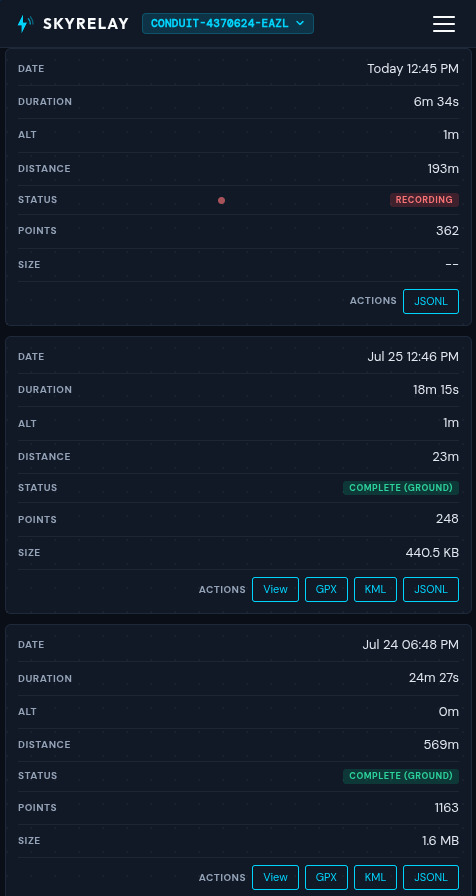
Logs stream off the aircraft over LTE as the flight happens and land in storage the operator controls — not the flight controller's SD card, not the manufacturer's cloud. A record that's already off the airframe before the aircraft lands is a record nobody on-scene can edit.
Link provides full MAVLink command-and-telemetry over LTE as the Alternate tier in a Primary/Alternate/Contingency/Emergency plan — a backup that engages when your RF datalink degrades, on a different carrier entirely. It is not sold as a replacement for your primary radio, and it doesn't behave like one.
After a hard landing, an aircraft that's off the network is still findable. Onboard GPS reports last-known position and an 85 dB piezo buzzer sounds on command — both running off the Conduit's independent battery, unrelated to the airframe's own power state.
The firmware running on the Conduit is downloadable and inspectable — you can confirm exactly what code is executing, not take a vendor's description of it on faith. Updates roll out over the same LTE link, so a fleet-wide fix doesn't mean shipping hardware back.
Flight records and positional history belong to the operator, exportable in standard formats on request. Nothing about accessing your own fleet's history requires going back through SkyRelay support, and nothing is held hostage by a subscription lapse.
One Conduit unit. What it does for a given aircraft depends on whether that aircraft shares its flight data.
| Capability | TrackClosed systems | LinkMAVLink airframes |
|---|---|---|
| Compatible platforms | DJI · Autel · Skydio | ArduPilot · PX4 · Cube · Auterion |
| Command-link takeover (PACE tier A) | Not applicable — no flight-data access | Included |
| GPS recovery + audible buzzer | Included | Included |
| Insurance-grade flight log | Included | Included |
Credibility here isn't a badge — it's the named carriers and flight stacks the Conduit already operates on.
No countdowns, no unit scarcity, no star ratings. What a risk-aware buyer actually needs to know before standardizing a fleet on this.
Flight logs and positional history are retained under the operator's account and exportable as CSV or JSON on request, with no minimum retention floor imposed by a subscription tier. Coverage across the networks the Conduit actually runs on:
An airframe goes down off-trail, out of radio range. The last GPS fix and buzzer activation, both logged off-aircraft before impact, put ground crew within meters of the wreck instead of searching a grid.
A claim hinges on the aircraft's state in the seconds before an incident. Because the flight record lives off the airframe and predates the claim, it stands as third-party evidence rather than the operator's own account.
The primary RF link degrades over a ridge line. Link's Alternate-tier LTE link keeps command and telemetry live on a different carrier, so the flight continues under control while the crew re-establishes primary.

Presented complete and unrounded — precision here is itself a trust signal.
| Spec | SkyRelay Conduit |
|---|---|
| Processor | ESP32-D0WD-V3 (dual-core, 240 MHz) |
| Cellular chipset | SIM7600NA (LTE Cat-1, 10 Mbps down / 5 Mbps up) |
| Bands | B2 / B4 / B5 / B12 / B13 / B14 / B66 / B71 |
| Carriers | AT&T, T-Mobile, Verizon — US · Bell, Rogers, Telus, Videotron — Canada (via Hologram, 550+ networks globally) |
| GPS / GNSS | SIM7600 integrated GNSS (GPS + GLONASS) · ±2.5 m CEP |
| Bluetooth | BLE 4.2 (Remote ID scan) |
| Battery | 18650 Li-Ion battery |
| Recovery buzzer | Passive loud piezo |
| MAVLink | MAVLink2 via UART or Bluetooth SPP |
| Interface cable | 4-pin JST SH1.0, 20 cm |
| Case | 3D-printed, gold |
| Dimensions | 125 × 40 × 47 mm (4.9 × 1.6 × 1.9 in) |
| Weight | 160 g (5.6 oz) |
SkyRelay uses Hologram IoT SIM cards — the SIM auto-selects the strongest available carrier. 550+ networks · 190+ countries.
| Carrier | Technologies |
|---|---|
| AT&T Mobility | 5G · LTE · LTE-M · NB-IoT |
| T-Mobile | 5G · LTE · LTE-M · NB-IoT |
| Verizon Wireless | 5G · LTE · LTE-M · NB-IoT |
| GCI Communications | LTE |
| Carrier | Technologies |
|---|---|
| Bell Mobility | LTE · LTE-M |
| Rogers Wireless | 5G · LTE |
| Telus | LTE · LTE-M |
| Videotron | LTE · LTE-M |
One 4-pin cable, pre-crossed inside the case, drops straight into a spare UART on any MAVLink flight controller — GND / 5V / TX / RX, no rewiring required.
Works with any MAVLink-capable flight controller with a free UART. Cube/Pixhawk-standard boards (JST-GH 1.25 mm TELEM ports) need a JST SH1.0-to-JST GH 1.25 mm adapter cable, sold separately.
The right next step depends on what you're responsible for.
One independent record format across a mixed fleet — closed-system airframes and MAVLink airframes alike — so incident review doesn't depend on which manufacturer built the aircraft.
For Fleet Operators →Flight records generated off-aircraft, before a claim exists, on infrastructure the policyholder doesn't control.
For Insurers →Where Conduit fits in a PACE plan — the Alternate and Emergency tiers, laid out plainly against your Primary and Contingency.
For Individual Pilots →